Dsmack is a protocol for verifying Apple App Attest evidence across developer accounts. An application can recognize approved code on someone else’s Mac, including copies signed by other developers.
Work requests open a GitHub issue. The bounty pilot uses testnet rewards.
For example, a bounty can require a particular test program. A contributor runs it on their Mac and returns its results with signed evidence identifying the app, test environment and task files. The verifier compares those records with the bounty’s requirements.
The repository includes smart-contract verifiers written in Solidity, a zero-knowledge proof implementation, and DsmackRunner—the macOS app that runs tasks in a Linux virtual machine.
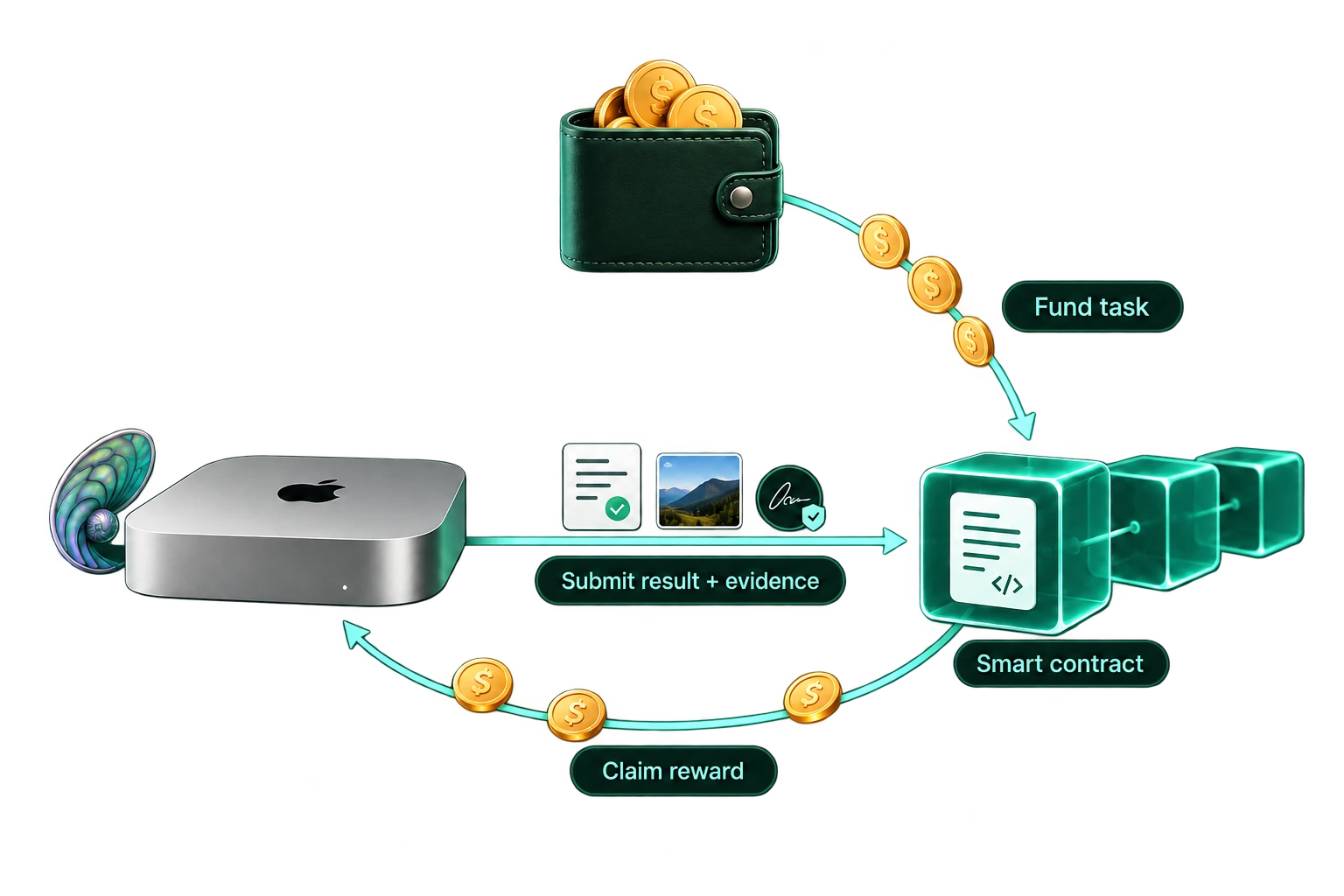
A bounty application: the requester funds the contract, a contributor submits a result with execution evidence, and the worker claims the reward. Follow the bounty example →
Shared Mac compute and open bounties.
APPLICATION DIRECTION
A peer-to-peer network of Mac minis.
A Mac owner could run a coding agent for someone else using spare machine time and their own subscription. The requester would receive the output and evidence identifying the program and inputs used. Participants could use their own Macs and developer accounts.
The app and verification code provide components for this network; a public service for matching requests to available Macs is still to be built.
A requester deposits a reward in a contract and publishes the tests a change must pass. A contributor submits a patch and evidence from running those tests. The contract pays according to the task’s verification rules.
In a pilot for Bounty Arcade’s Board app, the demo operator added card search, passed the browser checks and withdrew a reward on Base Sepolia, an Ethereum test network. A verifier running outside the blockchain checked the evidence and signed the decision the payment contract accepted.
App Attest lets a recipient verify that a signed message came from a particular app on genuine Apple hardware.
Dsmack uses it for records of a task run: which software and input files were used, and what results came back. A requester can check those records against the task’s requirements, even when someone else operates the Mac.
Apple designed App Attest for an app developer’s server to recognize its own app. Dsmack makes these checks available to peers and smart contracts, including apps signed under different developer accounts.
How can different developer accounts run the same approved code?
Apple’s evidence includes the app’s identity and a hash of its signed code directory, called its CDHash. Signing the same program under another developer account changes that identity and hash.
Dsmack’s code registry compares a measurement of the program that leaves out specified account and signing fields while retaining the code pages and specified security settings. Another developer can register a renamed, re-signed copy of an approved build by showing that this measurement matches. The verifier still checks the copy’s App Attest identity and CDHash.
Applications decide which program measurements to accept. That decision can be recorded in a public smart contract, so participants can inspect the same list of approved code.
Check the certificates in Solidity
Smart contracts verify Apple’s certificate signatures and store the app’s public key. Later transactions check messages signed by that key.
Prove the certificate checks were performed
A computer runs the certificate checks and produces a zero-knowledge proof that the required calculations passed. A contract verifies that proof instead of repeating all those calculations. It then checks the app’s later signed messages.
A signed macOS app starts a Linux virtual machine and signs statements about its launch and result. Linux runs the task in a container: a package containing the program and its dependencies.
DsmackRunner · the signed macOS app
Checks boot and task files against expected hashes, starts Linux, and signs the execution records after the VM stops.
Reusable Linux VM image
Linux, Docker, and a supervisor program that starts the task and collects its outputs.
Task container · supplied for this application
The task specifies the container image, command, input files, memory limit and network permissions.
Coding agentBrowser / CI tests
Returns output files and a result record.
A browser checker and a coding agent can use the same Linux image, with their tools in different containers. Scripts on the Mac prepare the task files. The app checks their hashes, runs the task, and signs the execution records. The recipient compares those records and outputs with its original request.
The setup guide walks through a browser task on your Mac. The bounty pilot adds testnet payments: its verifier checks the run outside the blockchain and signs a decision for the payment contract. The App Attest contract examples demonstrate certificate verification directly on-chain. The Mac execution prototype currently trusts the owner not to tamper with VM storage.